Tuesday, March 18, 2014

It's Coffee Time!

Hondurans love coffee, as a morning wake up beverage, in the afternoon for 'cafe-cito' and in the evening after dinner with a little 'pan dulce' or sweet bread.  At this time of year coffee has another significance as now it is harvest time.

Many of the people we know here are very involved with growing coffee, either as a property owner, a land manager or a worker who looks toward the seasonal employment at harvest time.

We went with a friend to a mountain property where her family grows coffee.  A fungus has devastated many of the coffee plants in Honduras, so they are having to cut down all the existing trees and plant a new resistant variety.

This is a fresh coffee bean with the skin removed to show the pulp around the bean.

We also went to a local "Secadora" or coffee dryer.  Here is a local man from the mountains who came in with a sack of fresh coffee beans.

The beans are weighed on a scale before being processed.

The beans are quickly examined and graded before moving on.

Next they are shoveled into the grate and travel underground via conveyor.

First stop for the beans is this giant hopper where they'll wait until there are sufficient beans to process.

There is an amazing amount of huge equipment all well maintained and very clean!

One of the great things here in Honduras is that they don't hesitate to let us climb up on all the equipment to get an an up close view.  This machine carefully strips the outer peal and pulp from the bean and then moves it on to the dryer.

These beans are in the dryer and it's a massive machine.  At one end is a furnace that you could literally walk in.  Interestingly they burn the white coffee hulls for the heat and fans blow it into the beans.  This machine drying the beans is at least two stories tall and rotates the beans from top to bottom for an even drying.  This is NOT roasting but only the drying process.

At the same place they also dry the beans outside on a concrete slab.  This is very common and we see people doing this all over.  Even parking lots are used to dry coffee at this time of year.  In the picture the two men are turning the beans for even drying.

They also use simple hoop greenhouses with just a common clear plastic stapled to the wood.  This is a more effective method than drying on the concrete slab.

Here coffee is drying out in front of a little house in the mountains.

Roasting the coffee is a totally different process.  People will dry their coffee to sell to companies who roast the coffee.  Some people will roast their own coffee in their home using a round pan over a wood fire.

Seeing the coffee drying outside this time of year is very common for us.  Hopefully this has given you a little glimpse into this process and the life of the people here.

Hondurans enjoy their coffee.  For many it is also their work.  We pray that the Lord blesses their labor and that in their work they see the goodness of the Lord!

Even so, I have noticed one thing, at least, that is good. It is good for people to eat, drink, and enjoy their work under the sun during the short life God has given them, and to accept their lot in life. Ecclesiastes 5:18

Thursday, February 27, 2014

Orphanage Visit

We visited Orphanage Emmanuel where we lead several short term teams before going full time.  We were interested in sharing information about heat retention cooking with some of the leaders, checking on what the status of the hospital they are going to construct, and give Kelly an opportunity to see all the changes to the orphanages as she was last there about five years ago.

This is a photo of the team house with our truck parked out front.  The team house can hold about 60 people and there was currently a large team there who were doing various construction projects including the final touches on a new house for the big girls.

One of the things that is so impressive about Emmanuel, which is home to about 600 children, is just how beautiful the grounds and buildings are!

We were able to spend a significant amount of time with the girl we sponsor.  We have been sponsoring her for seven years, which was when she first came to Emmanuel, and now our relationship is very different as we can actually have a conversation with her!

Matt was able to give a Bible lesson to the "Power Toddlers."  These are 35 little guys with lots of energy!

The lesson was on Christ being our King and how when we put our lives under Him we do so for protection, provision and salvation, and in turn Christ has total reign over our lives.

These little guys pray hard, they pray with force and it is such a good example for all of us!

This is the new "Big Girl's House" that was finish and had this opening ceremony welcoming the girls to their new home!

Katja, to the right of Matt, is the Administrative Director of the orphanage and her husband, Max, oversees the little boys house.  We were able to spend an evening with them, share the heat retention lesson and make a bunch of balloons with their kids.  Katja actually cooked her first meal using the cooker the very next day!

Ellen and Kelly spent several mornings at the clinic taking care of six month filing backlog!

They also tackled a little construction project in the clinic.

Here Ellen is plugging in the newly mounted lighted examination scopes and Kelly is cleaning up the dust!

Proud trabajadoras (workers)!

We all spent a lot of time out in the special needs yard just playing with and loving on the kids.

This little guy with the blue balloon hat was burnt over much of his body in a fire at another orphanage.  He is doing very well and really enjoyed his balloon hat... then a balloon sword... followed by a balloon dog... and many more!

Our time at Emmanuel went very quickly.  We really enjoyed getting to meet the folks there on the construction team.  The majority of the team were all retirees who had been coming for years.  They could be going other places and spending their time in tours and leisure, but they have chosen to set aside from one to three weeks a year to serve.  In talking with them it was also obvious that they have remained faithful in serving in their home church also.  The oldest team member was 93, he still gets down to the wood shop making things like shelves for the new house, and he has a very strong testimony about living for Jesus!

Friday, January 24, 2014

A New Year and We are Off and Cooking

It seems amazing that 2014 is here and we're already back into ministry in Honduras!

One big joy for us is that our daughter Kelly came to Honduras mid-January and will be here for most of February.  She has completed a two year program in the Philippines in a Christian birthing clinic where she "caught" 92 babies!  She is certified by the North American Registry of Midwives and is now pursuing options to use her training on the mission field.  She's talking to some doctors, checking out clinics and visiting various ministries while in Honduras.

Kelly jumped right in with helping us here in the various daily projects we are doing.  Here she was helping to fill a new heat retention cooker.

We fill the bags with rice hulls that act as insulation for the cooker.  The wind was causing the hulls to blow all over the place, including into our eyes.

Here Kelly is closing the bag by hand sewing the fill hole.

We had our first heat retention cooking presentation at a ministry that works with single teen moms.  They have 12 girls, their 12 babies and two "Tias".  Tia means "aunt" and these are women who help oversee the daily operations.  Some of the girls come to them as young as 12 years old, their need is for help be a mom and also help in growing up themselves including finishing school.

We wanted the girls to get to taste two types of food with the heat retention cookers and so we made both chicken with rice and frijoles (beans).  We have a problem in transporting the prepared foods because we have to drive over very rocky dirt roads and some rather steep hills.  So, to minimize clean up we placed the cooker in the black trash bag and the pot with frijoles we "cooked" using our cooler.

We start the lesson by explaining the heat retention cooking process and then serving up the food.  The young moms loved the food!

Even in a nice facility like the one they live in, with an indoor kitchen and electric stove, they still cook daily with wood.  Why they do this is simply because they cook beans daily and it takes three to four hours.  That would be a lot of electricity and so they opt for an outside stovetop that uses wood.

Now imagine their reaction when they learn they can simply boil the beans for 15 to 20 minutes and then put the pot in a heat retention cooker for four, six or even eight hours!  They are really excited about heat retention cooking!  It's significantly less wood, less smoke exposure, less opportunities to be burned by the fire, less possibility that the food will be burned... there are such big positive gains from heat retention cooking!!

Kelly served Janet, home director with her husband Greg, a sample of the cooking.  Janet loved it and was thrilled to have her own cooker!

As the young moms and children finished up eating, Ellen went over the lesson and answered questions.  Most questions are really just asking for a repeat of what's already been taught and discussed.  It's ok and expected, as this is a paradigm shift in cooking and so it takes a little time and processing for anyone to accept this new way of cooking.

After they tasted how good the food was, we moved on to dessert... the spiritual lesson.  It was a sweet time of discussing "How do we, as believers, maintain our spiritual heat, our passion, for Jesus?"  We know that not all the girls are believers and this is a great opportunity to share with them what are the disciplines that need to be in a believer's life so they can see part of what it means to be a disciple.  When we share these disciplines we also read and discuss verses that go with them:

   Read the Bible: John 20:30-31, 2Timothy 3:16-17
   Fellowship: 1John 1:3, 1John 1:7
   Pray: Ephesians 6:18
   Share the Gospel: Mark 16:15, Acts 5:42
   Serve Others: Ephesians 6:7
   Go to Church: Hebrews 10:24-25:

"And let us consider how we may spur one another on 
toward love and good deeds, not giving up meeting together, 
as some are in the habit of doing, but encouraging one another - 
and all the more as you see the Day approaching."

The directors are doing a magnificent work loving and discipling, and have even had the pleasure of seeing some surrendering their lives to Jesus and being baptized!

We feel very privileged to be able to spend time sharing a meal, teaching and fellowshipping with these little ones loved by God.

Greg and Janet are sweet, sweet Christians who, as are we, are giving themselves freely that some may be saved!!  We are so thankful for their friendship!

Wednesday, September 25, 2013

Tamalitos with the Neighbors

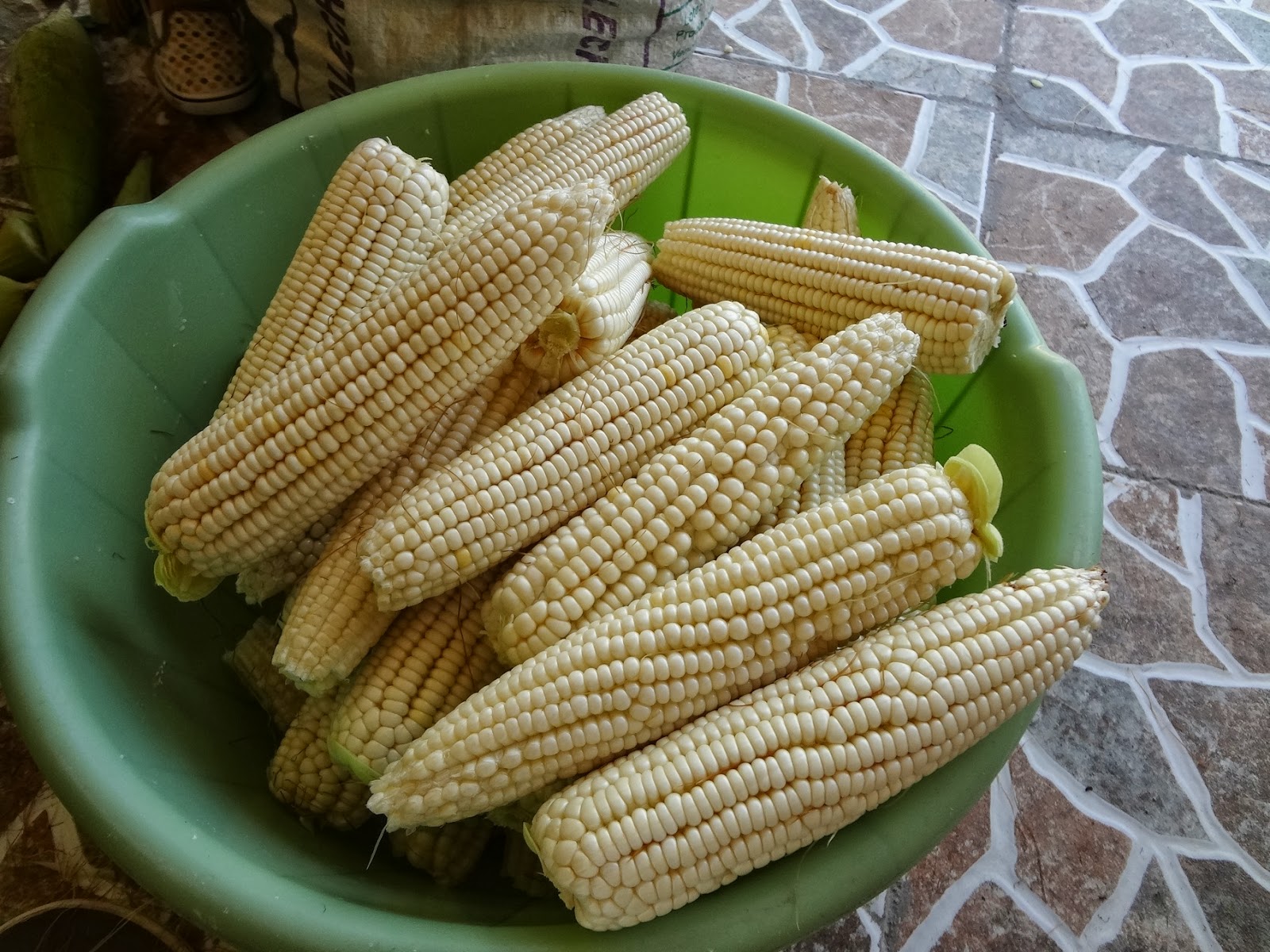
We had a great corn harvest from our backyard this year and decided to try making tamalitos.  Matt's become really good at growing corn, but then again, he always was a bit corny!

I had never made tamalitos and asked my neighbor, Noya, if she would teach me how.  So she invited me into her kitchen to learn.  Tamalitos are only made with new fresh corn that still has some "milk" in the kernels.  It's a simple food of ground corn and a little sugar.

Noya and her husband, Alexander (above) and I had a little corn shucking party on their front porch.

The corn is not shucked in the usual way of simply pulling off the tulsa, or husks, but rather by first cutting around the base to preserve the "tulsa" for wrapping up the tamalito.

Here's our bucket of "tulsa" ready.

Noya was so fast as she cut the corn off the cob.

We had to go across town (~4 blocks) for our next step to grind the corn. The woman in the blue shirt has a little home business of running a big electric grinder.  She charged me 50 cents, which is the normal rate.

The grains of corn were passed through twice to be extra fine for making tamalitos.

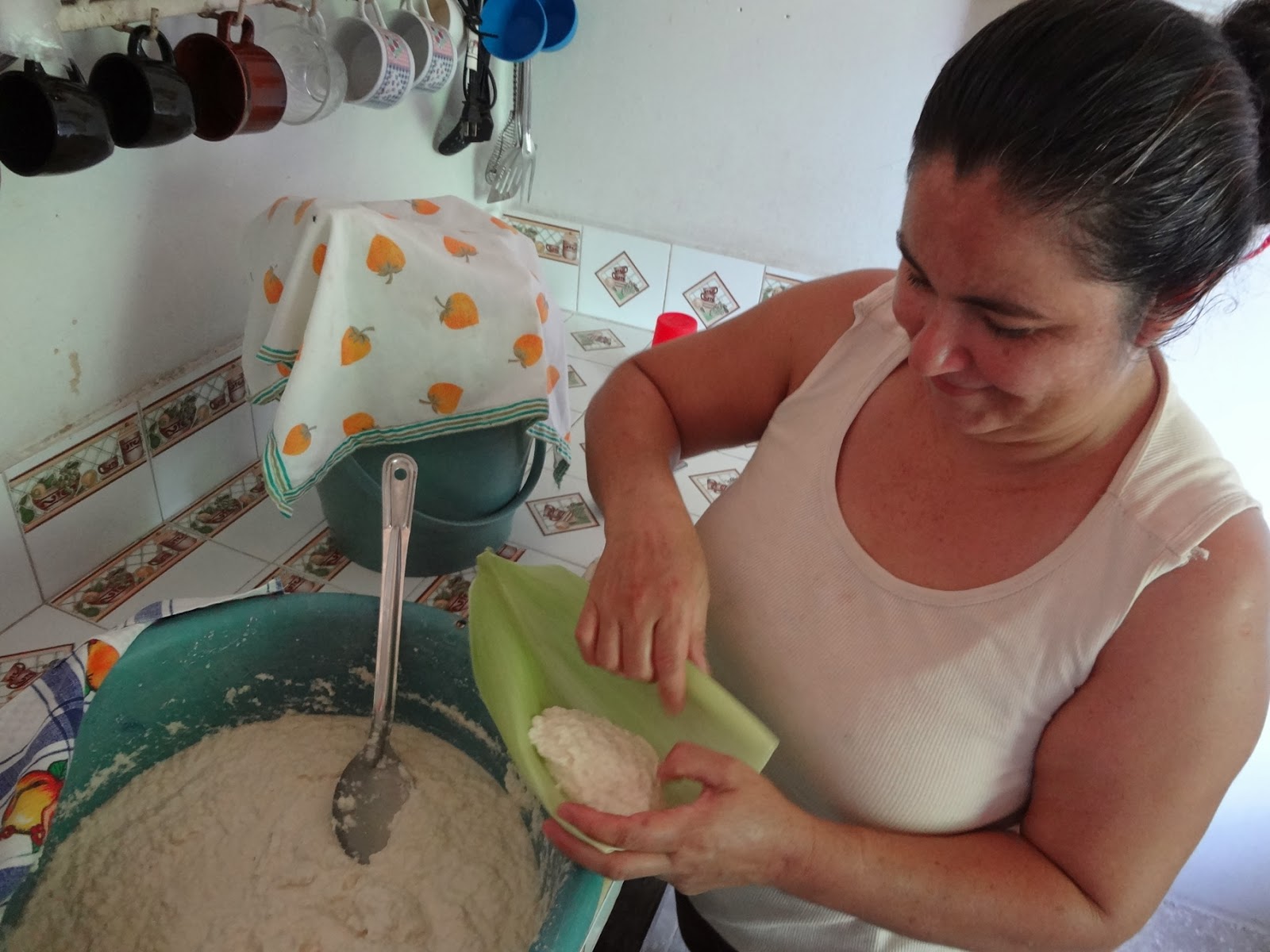
Back in Noya's kitchen, we put a little sugar into the ground corn and then put a spoonful of the mixture into the "tulsa."  Noya made it look way easier than it really was.
Basically, each tulsa gets a big spoonful of very liquidy corn glop.  The big trick was keeping the corn glop in the tulsa as I rolled the edges around the glop and then turn up the end.  Trust me, it takes practice... or maybe being born Honduran.  :)

After each tulsa is filled, rolled and closed off on one end, it's put in a pot.  This is another skill that's very easy to take for granted as they have to be placed together just so in order that they don't fall over in the pot.

Here's our full pot almost ready to be put on the fire.

Here you can see the pot with the wood fire behind it.

The final step before cooking was putting a few more pieces of "tulsa" over all the tamalitos and then carefully pouring in about an inch or two of hot water so as to steam the rolls.  After the lid was on the top of the pot, we wait.  The tamalitos cooked for about 45 minutes, until they were firm.

Here's a picture of a cooked tamalito (right) alongside a tamale (left). (Tamales are made with corn, too, but a completely different recipe.)  Often our Honduran friends will make a meal of just tamalitos. While we do well to eat one or two because they are so filling, our friends will eat four, five, six or more in one sitting!

A week later, Matt and I decided to try and make them ourselves.  Halfway through, we had Noya come over to check on us.  She was excited to see "her students" practicing their new skill set!

¡Buen provecho!  (Enjoy your meal!)